

Practical obstacles in implementation
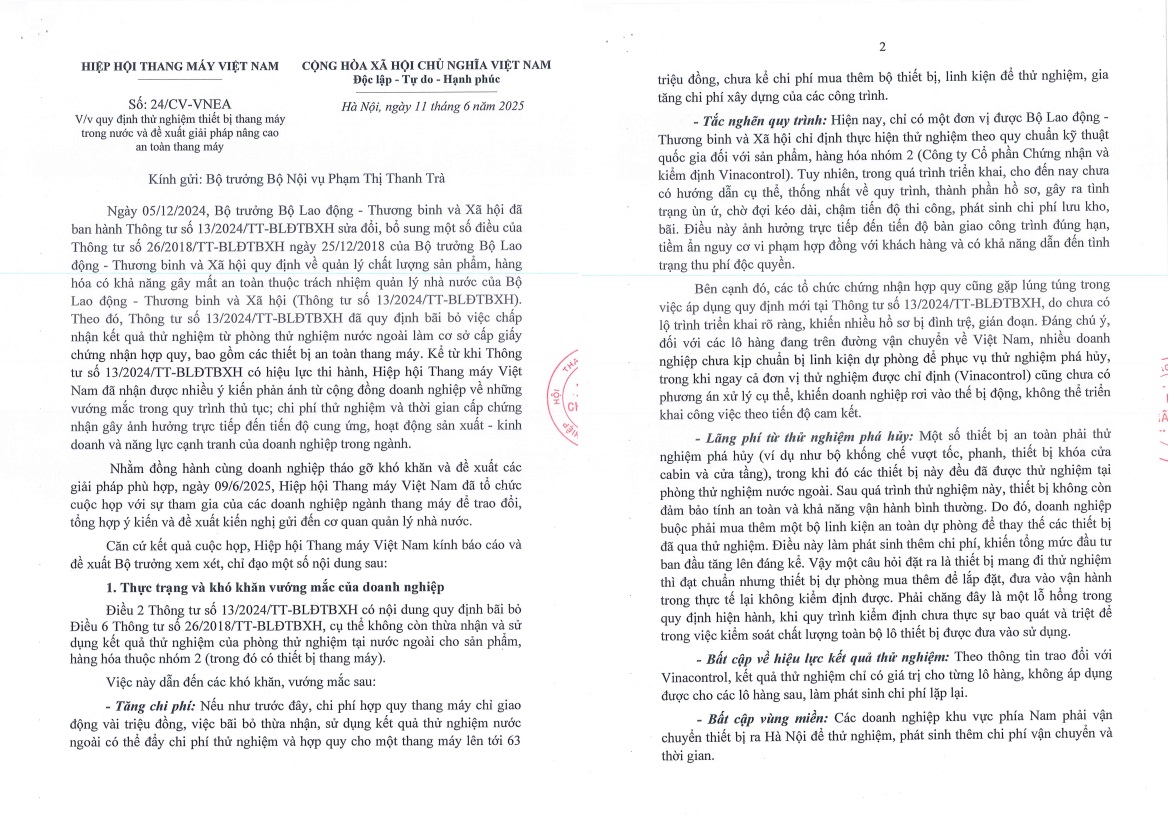
Circular No. 13/2024/TT-BLDTBXH, issued by the Ministry of Labour, Invalids and Social Affairs on December 5th 2024, entered into force on February 1st 2025. One of its key provisions is the revocation of the regulation permitting the use of foreign laboratory test results as the basis for issuing Certificates of Conformity. No additional implementation guidelines were provided, except Decision No. 496/QD-BLDTBXH dated February 27th 2025, which designates Vinacontrol Certification and Inspection Joint Stock Company as the sole designated testing organization.
Following the Circular’s effective date, the Vietnam Elevator Association (VNEA) received numerous concerns from the business community regarding procedural obstacles, testing costs, and certification delays, all of which have had direct impacts on supply timelines, manufacturing and business operations, and the competitive capacity of enterprises in the sector.
In light of this situation, and with the aim of accompanying enterprises in overcoming challenges and proposing suitable solutions, on 9 June 2025, VNEA organized a consultative meeting with elevator companies to discuss, compile opinions, and formulate a set of recommendations submitted to the Ministry of Home Affairs.
Removing unnecessary technical barriers to uphold the spirit of Resolution No. 68
Based on the outcome of the meeting, VNEA is of the view that, in the context where the technical capabilities and equipment infrastructure of domestic conformity assessment bodies have yet to adequately meet practical demands, the revocation of the recognition of international test results is currently inappropriate.
Many imported elevator components have already undergone testing at laboratories accredited under ISO/IEC 17025 and have received internationally recognized certifications such as the CE mark, or comply with the European elevator standards EN 81. Nevertheless, enterprises are still required to repeat the testing in accordance with Vietnamese standards, even though the substantive technical content is essentially equivalent.
At present, developed countries generally implement mutual recognition arrangements for products manufactured in accordance with the same international standards. The recognition of international test results not only contributes to cost and time savings but also enhances the competitiveness of enterprises amid the global integration process.

Enterprises have expressed concerns that prolonged testing procedures and delays in obtaining the certificate of conformity could significantly hinder project handover schedules under signed contracts with their clients. Conformity assessment bodies themselves are also facing confusion regarding the changes introduced in Circular No. 13, resulting in backlogs of documentation for imported shipments without clear procedures or resolution mechanisms in place.
In its written petition, Vietnam Elevator Association (VNEA) emphasized that, under Resolution No. 68-NQ/TW dated May 4th 2025 of the Politburo, the development of the private sector must be linked with a business environment that is “open, transparent, low-cost, and internationally standardized.” The removal of unnecessary technical barriers is essential to ensuring compliance with the spirit of this resolution.
At the same time, Clause 2, Article 26 of the Law on Product and Goods Quality (2007) clearly stipulates: “The recognition of conformity assessment results for the purpose of state management shall be carried out in accordance with international treaties or agreements to which the Socialist Republic of Vietnam is a signatory or contracting party.”
This provides a legal basis for recognizing conformity assessment results with international validity, thereby avoiding regulatory overlap, reducing unnecessary costs for enterprises, ensuring alignment with international practices, and supporting efforts to reform the domestic business environment.
Recognition of international test results and extension of validity periods
Grounded in actual market conditions and in line with the strategic direction for developing a modern and safe Vietnamese elevator industry that contributes to the nation’s socio-economic development, VNEA respectfully recommends that the Ministry of Home Affairs consider, instruct, and coordinate with relevant ministries and agencies on the following:
1. On the feasibility and practical effectiveness of Circular No. 13/2024/TT-BLDTBXH
VNEA proposes a reassessment of the necessity for promulgation, implementation feasibility, and actual effectiveness of Circular No. 13/2024/TT-BLDTBXH under current conditions; ensuring it is compatible with the domestic technical infrastructure capacity and avoiding the imposition of unnecessary technical barriers, costs, and administrative procedures that negatively impact business operations.
Timely review and adjustment would help materialize the Politburo’s directive as stated in Resolution No. 66-NQ/TW dated April 30th 2025, to “turn institutions and laws into a competitive advantage, a solid foundation, and a strong driver for development,” meeting national development demands in the new era.
2. On the recognition of international test results
It is proposed that test results of elevator equipment and components already assessed by internationally accredited laboratories be accepted – particularly for destructively tested components to minimize costs, avoid waste, and align with international practices.
3. For domestically manufactured equipment or those without existing international test results
– Development of testing infrastructure: Expand the national network of testing laboratories, ensuring geographical balance across the North, Central, and South regions. These labs must meet quality, objectivity, competitiveness, and transparency standards, while fulfilling current and future testing needs.
– Validity period of test results: Introduce a flexible and extended validity period for test results, applicable to product batches of identical model and technical specifications, to prevent redundant testing and reduce avoidable costs for businesses.
Through its written submission to the Ministry of Home Affairs, VNEA affirms its willingness to work closely with competent authorities in formulating and implementing policies; completing foundational technical standards; developing an equipment identification code system; enhancing workforce quality; implementing safety enhancement measures; and building a sustainable ecosystem for Vietnam’s elevator industry in line with the directive spirit of Resolution No. 66-NQ/TW dated April 30th 2025 of the Politburo on reforming the process of lawmaking and law enforcement to meet national development goals in the new era.
VNEA sincerely hopes that the Ministry of Home Affairs will consider and provide timely solutions to help ease difficulties, create favorable conditions for sustainable enterprise development, and contribute to the advancement of the private sector in line with the strategic orientation of the Party and State.